

Argentina needs better labour rights for the 21st century: shorter working hours, longer leave and policies for more rest and control over working time. A new working day is desirable and possible: it is about working better to produce more.
The longest working day in the world
Argentina is among the countries with the longest legal working hours in the world. The working week was set at 48 hours in 1929 and has not been changed since then.
Our average weekly working hours are 37 hours. Sixty-six per cent of registered employees work less than 42 hours per week. However, this occupational category has the highest percentage of workers who work more than 42 hours per week (34%). They rank above self-employed workers (30%) and unregistered employees (27%).
La distribución del tiempo de trabajo también varía por sector productivo. Existen sectores con un alto nivel de jornadas extensas en el trabajo principal (por ejemplo, en comercio o construcción). En otros sectores, como educación, servicio doméstico y salud, las jornadas en el trabajo principal no son tan extensas porque existen altos niveles de pluriempleo.
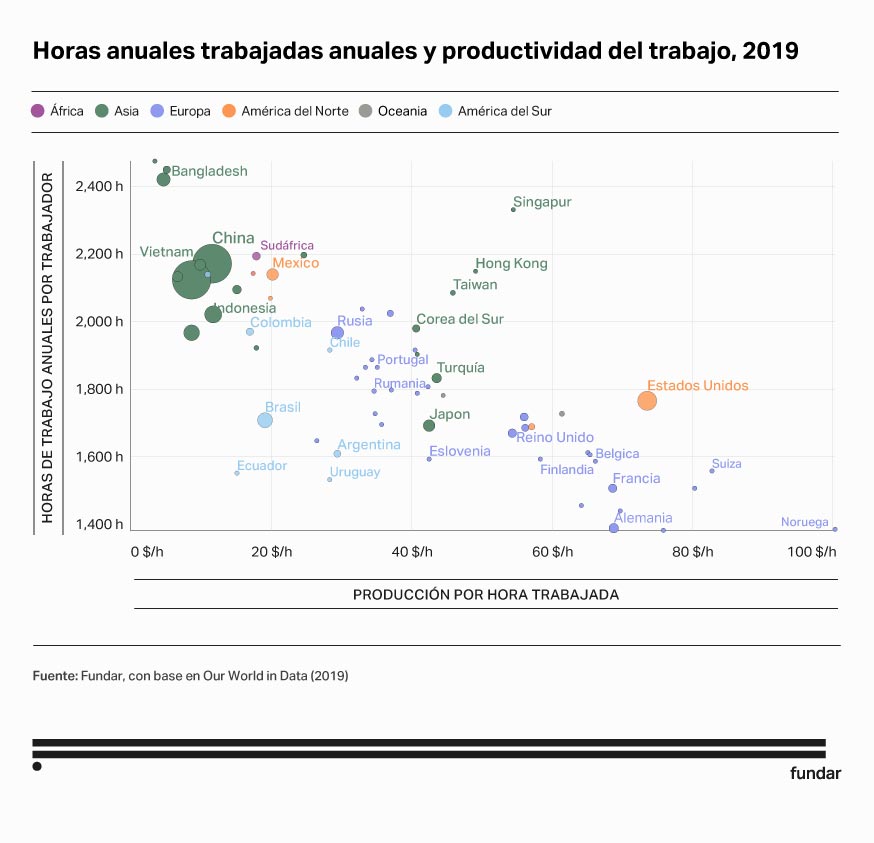
Work better, produce more
It is possible to work less, work better and produce more. There are countries where shorter working hours and high levels of productivity coexist. In these cases, productivity is explained more by the introduction of technologies, better work organisation or innovation in production processes than by the intensification of labour.
Birth licences, 50 years late
Maternity, paternity and parental leave schemes in Latin America, the Caribbean and the European Union
| Country | Paternity leave (days) | Maternity leae (weeks) | Parental leave |
| Haití | 0 | 12 | 0 |
| Cuba | 0 + parental | 17 + parental | 1 year from birth (60% salary)
|
| Argentina | 2 | 13 | 0 |
| Bolivia | 3 | 13 | 0 |
| Nicaragua | 5 | 12 | 0 |
| México | 5 | 14 | 0 |
| Brasil | 5 | 17 | 0 |
| Colombia | 8 | 18 | 0 |
| Venezuela | 14 | 26 | 0 |
| Paraguay | 14 | 18 | 0 |
| Chile | 5 + parental | 18 + parental | 12 weeks (100% salary) or 18 weeks (50% salary)
|
| Ecuador | 10 + parental | 12 + parental | 9 months (0% salary)
|
| Uruguay | 20 + parental | 14 +parental | 6 months from birth (50% salary)
|
| UE | 10 + parental | 14 + parental | 4 months (100% salary)
|
| France | 28 | 16 | – |
| Spain | 112 | 16 | – |
| Finlandia | 160 | 22 | – |
| ILO Convention 183 | – | 14 | – |
| ILO Recommendation 191 | – | 18 | – |
Public policy recommendation
Three public policy lines are proposed for the expansion of labour rights in the 21st century: reduction of working hours, extension of maternity leave and new breaks.
Although this proposal does not solve certain problems related to poor job distribution (underemployment or multiple jobs) nor does it generate employment, it does improve the quality of life of those who are currently overemployed.
Whether through a reduction in working hours, a better work-life balance, or a redistributive effect on the incomes of those who work the most, the proposal improves the quality of existing work.
Reduction of the legal working week from 48 to 42 hours
En una implementación gradual y escalonada en un período de cuatro años, afectaría potencialmente al 34% de los asalariados registrados (y al 17% de los ocupados). Esta reforma no sirve al objetivo de generar empleo, sino que busca mejorar la calidad del trabajo que resulta de la política económica y el crecimiento del producto. Estaría traccionada por la vía de la reducción del tiempo de trabajo o el aumento de los ingresos. O se reducen las horas efectivamente trabajadas o se mantiene las mismas horas trabajadas pero bajo mejor remuneración ya que son consideradas como horas extraordinarias.
Extension of licences due to birth
Extend paternity leave from 2 consecutive days to 14 consecutive days and extend maternity leave from 90 consecutive days to 98 consecutive days. CIntroduce 12 weeks’ parental leave following the birth of a child, to be shared between the parents as they wish, starting at the end of paternity or maternity leave.
Flexible working hours for the benefit of employees, digital disconnection and new breaks
Recognising new rights in relation to: flexible start and finish times, interruption of the working day due to force majeure, combined hybrid working arrangements, guaranteed minimum hours in contract or piecework contracts, preferential organisation of the hour bank for the benefit of the worker, digital disconnection, extension of ordinary annual leave to a minimum of 15 working days and preferential use of holidays.
