

The “chainsaw” became the emblem of Javier Milei’s government and sums up his plan to downsize the state. Between December 2023 and October 2025, the national government reduced its workforce by 17.25%, and the number of senior organisational units in the centralised administration fell by around 40% between December 2023 and July 2025. The use of powers delegated by the Basic Law also made it possible to recentralise agencies and eliminate functions considered “unnecessary”.
The government justifies the changes made to resolve three problems: overlapping functions, organisational oversizing, and the presence of tasks that it considers unnecessary for the state to perform. But what kind of state is Milei building? An AI-based analysis of the reduction of duplication, the impact on substantive and support units, and the model of the state that this reconfiguration expresses.
Chainsaws in data
Indeed, the overlap of functions was reduced, although certain duplications remain. In particular, we observed this in the Government Centre and in an overlap between interministerial coordination tasks and in the relationship between the Nation and the Provinces. Between 2023 and 2025, the proportion of units with highly similar functions (identified using artificial intelligence) fell from 12.7% to 6.5%. In other words, although the cutback reduced overlaps, it did not eliminate them.
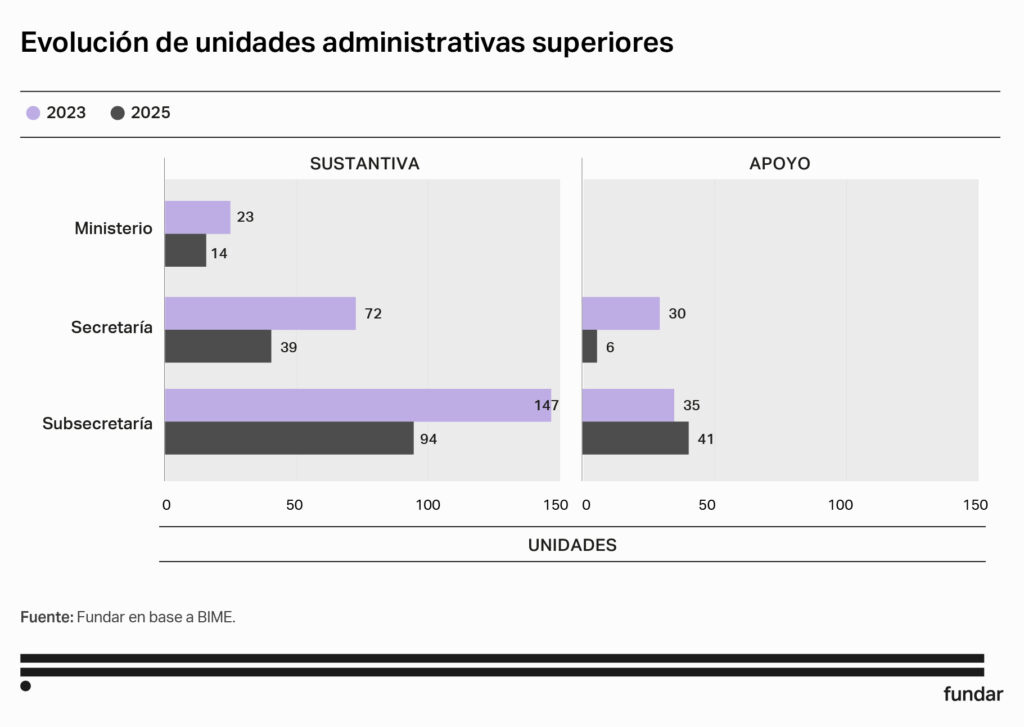
At the senior level (ministries, secretariats and undersecretariats), the chainsaw eliminated substantive units (which implement policies) and administrative units (which manage internal resources), but did so to a greater extent in the former. Although upper-level support units decreased by almost 30%, the reorganisation had a paradoxical effect: administrative secretariats shrank and undersecretariats grew. This resulted in a more bureaucratic-administrative structure for fewer functions. According to the available information, at lower levels (directorates/coordinating offices), the cuts deepened this disproportion between substantive and administrative areas.
The cuts were not neutral: the emerging model of the state prioritises security and defence functions. Analysis by public policy area shows that the chainsaw had the greatest impact on functions associated with social policy, labour, housing, gender and diversity, and the environment, which lost almost half of their units between 2023 and 2025. In contrast, security and defence remained stable or grew. This pattern suggests that the state reorganisation not only reduced structures for reasons of efficiency, but also reoriented the role of the state towards public security functions.
Artificial Intelligence for comprehensive analysis
The tool developed in this work contributes to the redesign of the state structure, based on a pioneering development by Fundar using Artificial Intelligence (Alessandro and Ortiz de Zárate, 2022) and applications generated since then by other organisations. The code is open source and can be found in our repository.
Normally, changes in administration are accompanied by changes in the cabinet and the structure that constitutes the State Map. The use of modern tools such as LLMs or more traditional ones such as those offered by PLN provides the possibility of constructing a rapid, low-cost diagnosis that does not require many man-hours on how the State is constructed from an organisational point of view. In other words, it would allow decision-makers to obtain information on the number of existing administrative units, their concentration around areas or public policy issues, and the level of overlap between them in a short time and at a relatively low cost.
Just as the use of LLMs is not a substitute for expert domain knowledge for overlap analysis, neither is it a substitute for its practical application to the design of the state organisational chart. The tool presented here is, in any case, the starting point for those responsible for the Executive Branch to carry out a qualitative analysis of those units they consider to be priorities based on the programmatic objectives defined by the new administration.
